
An Epiphany About Bravery
The times we live in provide ample opportunities for us to be afraid. The Rt. Rev. Mariann Budde, Bishop of the Episcopal Diocese of Washington, DC, writes about how ordinary people develop the capacity to act with conviction even when afraid. I invite you to read Bishop Budde's works:
- •How We Learn to Be Brave: Decisive Moments in Life and Faith by Mariann Edgar Budde
- •We Can Be Brave: How We Learn to Be Brave in Life's Decisive Moments by Mariann Edgar Budde and Bryan Bliss
- •I Can Learn to Be Brave (Written for children!) by Mariann Edgar Budde and Holly Hatam
In the 1950's, my family owned a wonderful piece of Colorado on U.S. Hwy 40 between Tabernash and Granby. I spent summers there where I could look in almost every direction and see towering Engleman Spruce trees, snowcapped peaks, clear running water, Aspens, and Lodgepole Pines.
One summer, Joe and Monroe, two friends from my Houston neighborhood visited me. Monroe was a little younger and we decided to play a game with him. The electric company had come through and cleared some trees that were growing beneath their lines. In the process, they left a pile of logs. Somehow, there was a hollowed out area in the pile. We asked Monroe if he was brave enough to go inside and see if there were any wild animals there. (We had already checked and knew there were not.)
Monroe, to our surprise, crawled inside and, when he came out, he assured us there were no wild things.
We felt a little embarrassed for the childish prank and decided we needed to recognize Monroe for his bravery. The electric company had also left some green glass insulators behind and we thought one of them would make a great award for Monroe. We quickly convened a little awards ceremony and presented Monroe with the prize for bravery.
Monroe cherished that prize. Even more, Monroe valued the spirit of bravery that earned it. He developed that spirit in the years ahead.
After high school, Monroe joined the fire department. He put that bravery to work extinguishing fires and saving lives. In time, he was diagnosed with a terminal respiratory illness, which was the result of inhaling toxic fumes while fighting fires. He fought that illness with the bravery he had grown since childhood. Monroe died an untimely death.
Monroe knew what was most important. He knew the importance of being surrounded by people who believed in him and supported him. And he practiced being brave, in small challenges as well as large ones. Those are interconnected capacities we all can learn.

I told my son that story when he was in elementary school to encourage him to be brave. One day he went to a garage sale down the street and came home with three green glass insulators. His mom helped him put them in a box with wrapping paper. He presented them to me and told me they were a prize for my bravery.
I didn't feel all that brave but in my little boy's eyes I had seemed brave. I still have those three insulators and when I see them they remind me to be brave. Like Monroe!
The Very Reverend Ron Pogue
The Epiphany in The Transfiguration of Christ
On the Feast of the Transfiguration, we celebrate that shining moment on the mountaintop when Peter, James, and John saw Jesus in a dazzling new light — and reflect on what such moments of transfiguration mean for our own lives.
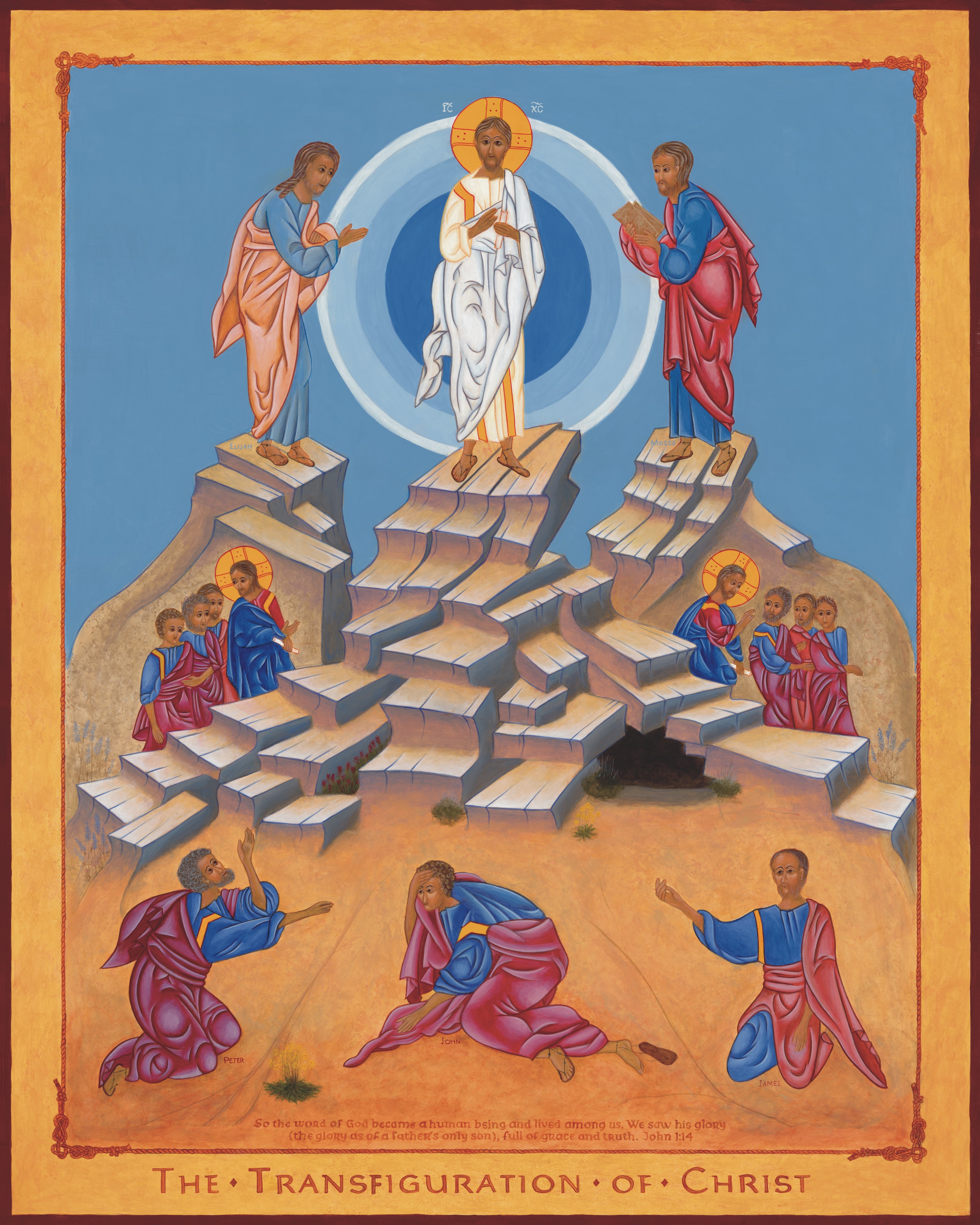
The Feast of the Transfiguration has been celebrated in at least some part of the Church since early in the 4th century. In the 10th Century, its celebration on August 6 began in England and Pope Callixtus III made August 6 the feast day throughout the Church in 1456. On this sacred day, we celebrate that shining moment on the mountaintop when Peter, James, and John saw Jesus in a dazzling new light, in a new way, and realized his divine role was unfolding before their eyes in the fulfillment of the Law and the Prophets.
It is a tragic irony that in 1945, August 6 became a day of disfiguration at Hiroshima. The transfiguration is the light radiating from Jesus, infusing the apostles with new life. What a distortion that light be used to burn rather than warm, to blind rather than illuminate.
And what a different reassurance from the gentle Jesus: "Do not be afraid." The apostles were frightened by the unfamiliar. The light of the transfiguration was a new revelation of Jesus of Nazareth. On the other hand, the clear message in 1945 was to be afraid.
The light in Hiroshima revealed a new power of destruction unleashed on the world. But it may be fitting for us to remember that amid the destruction wrought by humanity there is Jesus, still present and still suffering in innocent victims but still radiant with the transforming power of God.
The apostles also were frightened by the possibility of too much joy. For the transfiguration was an affirmation of Jesus, a hint of the unimaginable, a foreshadowing of the boundless life of the risen Christ.
They, of course, resisted the experience. Afraid of the intensity, of the unknown, of life and power so beyond theirs, they backed away. On the brink of an encounter that offered them a new vision of reality, they hid their faces.
On our own mountains of experience, we are no different. The unfamiliar discomforts us, the unknown frightens us, even with the offer of new life. Encountering great love or deep emotion, we fear lack of control and loss of self, so we use speech to dispel the experience and regain solid footing. We are afraid of seeing in a new way someone we have neatly classified, afraid of having our minds changed, our hearts moved, our soul turned inside out. Comfortable with our everyday, slightly despised mediocrity, we shy away from revelations of the intimate closeness of the transcendent God.
We are earthen vessels. Jesus was a crystal vial. Infinitely more transparent and sensitive to the Spirit than we, he emanated the brilliant radiance of that presence. Such affirmation as a beloved Son must have served him in the moment of anguish and apparent abandonment on the cross that was soon to follow when they left the mountaintop. Peter wanted to stay there but that's not what mountaintop experiences are for. They are to prepare us, inspire us, encourage us for the ongoing journey of life and faith.
This gospel reminds us of transfigurations in our own lives. These are the moments, always pure gift, never earned and never manufactured, when we are aware of God's presence and power – that time when after a death we know with certainty that the one we love is alive, still near us and loving us; the time of prayer when God takes over and we know with the knowledge of experience that "it is an awful thing to fall into the hands of the living God;" the times of intimacy so bright and intense that boundaries between people melt and self-gift becomes self-expansion.
May God open our eyes, our hearts, and our minds to recognize and embrace such moments of transfiguration.
The Very Reverend Ron Pogue
I'm Back!
After Typepad's closure ended nearly two decades of blogging, a new chapter begins — rebuilt and renewed with the help of GoDaddy Airo.
Last year, Typepad, the host for my E-piphanies.com blog since 2007, went out of business. After months and wasted time and money, GoDaddy solved my problems!
GoDaddy has always been the domain host, just not the blog host. They now have a service called Airo that is helping me rebuild my blog using a web archive. More to come!
The Very Reverend Ron Pogue
Invitation to a Holy Lent
With the sign of a cross of ashes imposed on our foreheads, we begin our annual Lenten journey — a season of reflection upon the impact we will leave in a universe that can and will go on without us.
Remember that you are dust, and to dust you shall return. With these words and the sign of a cross of ashes imposed on our foreheads, we begin our annual Lenten journey. Those ashes, made from the palm branches we waved as we sang hosannas in celebration of Christ's Triumphal Entry last Palm Sunday, are a sign of the tentativeness of our praises and the shortness of our lives in the grand scheme of things. They mark the beginning of a season of reflection upon the impact we will leave in a universe that can and will go on without us.
Anglican priest and physicist John Polkinghorne expanded my own thinking about those ashes and our place in this universe in his book Quarks, Chaos, and Christianity. He writes, "Every atom of carbon inside our bodies was once a star. We are all made from the ashes of dead stars." Then, he goes on to explain how special our universe is. "Only a cosmos at least as big as ours could endure for the fifteen billion years necessary for evolving carbon-based life. You need ten billion years for the first-generation stars to make the carbon, then about five billion years for evolution to yield beings of our sort of complexity."
Woven into the complexity of our life is the "invincible divine purpose for good" and "the faithfulness of God who will not allow anything good to be lost." The death and resurrection of Christ bear witness to that truth and constitute the "seed event" of the new creation. From that "seed" springs forth fruit in the lives of those who follow him. So, when you receive those ashes, marked on your forehead in the sign of the cross of Christ, receive with them the invitation to examine your life, seek what is good, and discard whatever interferes with the fruitfulness and goodness you may contribute during your brief sojourn.
If you are considering a Lenten discipline, perhaps these words of wisdom from the early Christian mystic St. John Chrysostom will be helpful to you: "No act of virtue can be great if it is not followed by advantage for others. So, no matter how much time you spend fasting, no matter how much you sleep on a hard floor and eat ashes and sigh continually, if you do no good to others, you do nothing great." So, whatever you give up or take on, let's ask ourselves if the practice will benefit others in some way and if it will help liberate us from indifference to our neighbors, especially those in need. I invite you, therefore, in the name of the Church, to the observance of a holy Lent, by self-examination and repentance; by prayer, fasting, and self-denial; and by reading and meditating on God's holy Word.
The Very Reverend Ron Pogue
In Celebration of Michaelmas
Today, September 29, is Michaelmas, The Feast of St. Michael and All Angels. I've been intrigued by angels for many years — and a rabbi's words about them have stayed with me ever since.
Today, September 29, is Michaelmas, The Feast of St. Michael and All Angels. Since this year the observance falls on a Sunday, the feast is transferred to Monday for public worship. I consider Michael to be my guardian angel, although I've been told that isn't possible. However, if you've ever been visited by an archangel, you know.
I've been intrigued by angels for many years. On numerous occasions, I've wondered if what I've experienced was because of the presence and ministration of an angel. I once asked my friend Rabbi Jimmy Kessler of Galveston to talk to me about the view of angels in Judaism. He told me many interesting things but the one that stays with me involves the role of angels in the providence of God. He said, "The rabbis said that God has assigned an angel to every living thing, even each blade of grass. The angel's job is to stand beside every blade of grass and say, 'Grow! Grow! Grow!'"
In celebration of Michaelmas, I wanted to share my appreciation of and curiosity about angels. The Psalm reminds us: "For he shall give his angels charge over you, to keep you in all your ways. They shall bear you in their hands, lest you dash your foot against a stone." (Psalm 91:11-12)
I hope you will benefit from reflecting on the angels in your life. Whether or not we are always aware of their presence, the tradition of the Church affirms that we are accompanied — that the God who set glory above the heavens has not left us to make our way alone through this world.
The Very Reverend Ron Pogue
A Biblical Perspective on the Treatment of Immigrants
The treatment of immigrants was a biblical and moral issue long before it became a political one. It is time that people of faith and people of conscience take back the narrative.
For a number of years, we have witnessed quite a lot of political rhetoric and harsh treatment of immigrants to the United States, especially along our southwestern border. The treatment of immigrants, whether legal or not, was a biblical and moral issue long before it became a political issue. It is time that people of faith and people of conscience take back the narrative! "When an alien lives with you in your land, do not mistreat him. The stranger who lives as a foreigner with you shall be to you as the native-born among you, and you shall love him as yourself; for you lived as foreigners in the land of Egypt. I am Yahweh your God." — Leviticus 19:33-34
Politically motivated disinformation and unjust and sometimes brutal policies carried out in the name of U.S. citizens have often been executed by and applauded by people who claim to be followers of Jesus Christ and who claim to be pro-family and believe in the sanctity of life. Nothing about these horrific solutions to our "border crisis" reflects the teaching of Jesus, protects families, or respects the sanctity of immigrant lives. Many of those entering illegally are not simply immigrants — they are refugees, fleeing violence and/or poverty in their own countries. There are international laws pertaining to how refugees are identified and how they are treated. We helped write those laws.
I am not suggesting that we have "open borders" or abandon all immigration laws. But I am advocating for less political theatrics and more collaboration on just and humane ways to treat those who are seeking a new life as neighbors in our country. Using human beings as pawns in a political game is cruel, un-American, and certainly contrary to biblical standards. The treatment of immigrants is a huge and unambiguous issue in the Old and New Testaments.
As you can see, fact-checking false claims about immigrants is not difficult. It is incumbent upon us as people of faith and as responsible citizens to deal with facts and seek the truth. I hope you will give this prayerful consideration and, if you are moved to speak or act as an advocate for just and humane immigration policies, may God give you the grace and the will to do so!
The Very Reverend Ron Pogue
A Call to Prayer
In both Morning Prayer and Evening Prayer, the Book of Common Prayer includes a series of intercessory prayers called Suffrages — prayers Anglican Christians around the world have been praying daily since 1549.
In both the offices of Morning Prayer and Evening Prayer, The Book of Common Prayer of The Episcopal Church includes a series of prayers called Suffrages. In ecclesiastical use, the word Suffrages refers to a series of intercessory prayers. The ones in the current liturgy are the latest version of Suffrages that Anglican Christians around the world have been praying daily since 1549. Notice that a little over half of the Suffrages are intercessions for the world, the nation, and the vulnerable.
The prayers we offer don't change God. They call upon God to express those divine qualities and yearnings God has already revealed to us through Scripture, tradition, reason, and experience. When words of prayers leave our lips, it is we who ought to be changed — to become more godly in our words and deeds. These Suffrages, then, prompt us to shape our lives and our behavior to align with the qualities and yearnings of God, especially toward the world, the nation, and the vulnerable among us.
When we pray prayers like this, to borrow a meaningful phrase from the late Congressman John Lewis, we are making "good trouble." When we pray prayers like this, we are on the verge of becoming the change we would like — and God would like — to see. When we pray prayers like this, we are stepping into the role of ally for those who work for peace and healing, seek justice and truth, and foster tangible hope for those in any kind of need.
As a response to the precarious situation in which we find ourselves, I am making a renewed commitment to pray the Suffrages every day. I invite you to join me. If you are inclined to pray the entire morning and/or evening office that would be great too. If something in your life changes because of this spiritual discipline, please let me know!
The Very Reverend Ron Pogue
An Epiphany in Faith Formation from a Lost Ball and a Trustworthy Dad
The greatest lesson I ever learned about faith I learned from my father — the day he boosted me onto the roof to retrieve a lost ball, and said, "Don't worry. I won't let you fall."
The greatest lesson I ever learned about faith I learned from my father. I had accidentally pitched a ball into a valley on the roof of our house. Instead of getting out a ladder and climbing up to get it for me, dad picked me up to boost me up onto the roof so I could get it myself. I had never been upon the roof before. It was frightening, mostly the getting-up-there part. When I began to express my fear my dad said, "Don't worry. I won't let you fall." His hands and arms felt strong. His voice was firm and confident. He had been on the roof himself. He believed I would be okay. So, I forgot my fears and found my faith and dad didn't let me fall.
Through the experience of trusting I discovered that my dad was trustworthy. I have been able to live my life with an abiding faith, often tested by the things that test everybody's faith. It goes back to that lost ball on the roof, my dad's strong and loving arms, reassuring voice, and dependable promise: "I won't let you fall."
That has made it easier for me to trust my heavenly Father who promised, "I will never leave you nor forsake you." Earthly parents, though fallible, have a role to play in the formation of faith in their children's lives. In fact, parents are the primary faith-givers. The chief evangelical opportunity for Christian parents is with their children. Even helping a child retrieve a toy stuck on the roof can be an occasion for faith forming.
The world needs dads to give their children a fear-conquering faith. Of course, moms do it too. But this is Father's Day. May all who are fathers — and all who have been shaped by a father's love — give thanks today for the gift of trustworthy love that points us toward the One who will never let us fall.
The Very Reverend Ron Pogue
The Mission Field at Our Doorstep
This reflection is about an epiphany from one of the saints I have known, Marjorie B. Lester — and the words she spoke that changed a congregation's giving and my own understanding of mission.
This reflection is about an epiphany from one of the saints I have known, Marjorie B. Lester. I became Marjorie's pastor at Houston's Bering Memorial Church in January of 1978 when she was 95 years old. Marjorie was born in Kentucky in 1882. Her father was murdered when Marjorie was not quite 5 years old. She married when she was 15, bore three children, and was widowed at the age of 46. Somehow, in the early years of her marriage, she managed to study law and was the second woman admitted to the bar in the Commonwealth of Kentucky. She died at the age of 101.
In October of my first year at Bering, our stewardship campaign theme was "Open the Doors." On the Sunday members were asked to complete their pledge cards, Marjorie raised her walking cane in the air and asked to say a few words to the congregation. She came to the front of the nave, stood facing those who were gathered there, leaned on her cane, and challenged everyone to give generously. She concluded her remarks by pointing to the doors of the church with that cane and saying, "The Apostle Paul would be envious of the mission field at our doorstep." 60% of the pledge cards turned in that morning had the original numbers erased or crossed out and higher amounts filled in!
Marjorie's closing words rang in my ears for the remaining eight years I served in that place and they have remained with me ever since. It became my practice at the end of the service to invite worshipers to turn and face the door of the church for the Dismissal — having been nourished by Word and Sacrament, sending Christ's followers into "the mission field at our doorstep."
Cardinal Jorge Bergoglio of Argentina once asked his fellow Cardinals and indeed the whole Church to consider "the times in which Jesus knocks from within so that we will let him come out." When the Church keeps Christ to herself and does not let him out, it becomes self-referential and sick. Jesus wants to lead us out into the mission field at our doorstep, as Marjorie so powerfully envisioned it. I am grateful she touched my life and, hopefully, many others who've heard my stories about her.
The Very Reverend Ron Pogue
The Tree of Wisdom
A Good Friday hymn written by a Seventeenth Century Hungarian poet — "There in God's Garden" — became one of my favorite hymns, with its message of hope for the healing of the nations.
Yesterday, a friend shared a couple of stanzas of a Good Friday hymn written by Seventeenth Century Hungarian poet Király Imre von Pécselyi and translated into English by Twentieth Century Congregationalist minister, composer, and musicologist Erik Routley. The common title of the hymn is "There in God's Garden" and it is also known as "The Tree of Wisdom." Alabama composer K. Lee Scott wrote the tune "Shades Mountain" specifically for this text.
I was introduced to the hymn during my two-year residence in Mississippi as Interim Dean of Jackson's St. Andrew's Cathedral. It became one of my favorite hymns, with its message of hope for the healing of the nations. Organist/Choirmaster Jessica Nelson led the Cathedral Choir and Congregation in singing it in my last Sunday service there, which was also the occasion for my retirement from active ministry.
"There in God's garden stands the Tree of Wisdom, whose leaves hold forth the healing of the nations: Tree of all knowledge, Tree of all compassion, Tree of all beauty. Its name is Jesus, name that says, 'Our Savior!' There on its branches see the scars of suffering; see where the tendrils of our human selfhood feed on its lifeblood."
"See how its branches reach to us in welcome; hear what the Voice says, 'Come to me, ye weary! Give me your sickness, give me all your sorrow; I will give blessing.' This is my ending, this my resurrection: into your hands, Lord, I commit my spirit. This have I searched for; now I can possess it. This ground is holy. All heaven is singing, 'Thanks to Christ whose Passion offers in mercy healing, strength, and pardon. Peoples and nations, take it, take it freely!' Amen! Our Savior!"
The Very Reverend Ron Pogue
Bob McKee's Advent Gift
Around the middle of Advent every year for a decade, our friend Robert McKee would invite us to join him for the Madrigal Dinner at Rice University — and the Wexford Carol became my favorite carol.
Around the middle of Advent every year for a decade, our friend Robert (Bob) McKee would invite us to join him and a group of friends for the Madrigal Dinner at Rice University. The event took place in the Faculty Club/Cohen House on the Rice Campus. Singers from the Shepherd School of Music, under the direction of Tom Jaber, dressed in elaborate Elizabethan costumes and sat at an elevated head table. From that platform, they sang carols and other music of Advent and Christmas. During the meal, magicians, jugglers, and acrobats entertained us. We always had a wonderful time and Bob's guests became our good friends.
I was reminded of those Madrigal Dinners, Bob McKee, our friends, and the glorious music today when I heard a recording of the Wexford Carol, the first verse of which was always sung a cappella at the very end of the evening. It became my favorite carol. It gladdens my heart at this time each year.
Those occasions brought people together and fostered lasting friendships. Our nation and our world need more such occasions and all the things the Messiah came to bring into the world. Bob has joined the Choir Immortal, as have several of the regular guests. Others remain in touch, though now scattered about the country.
Through the years, we've moved around quite a bit and more friends have entered our lives. Gay and I give thanks to God for them and all of you. We pray that you have a blessed Christmas and a New Year filled with love, peace, and goodwill!
The Very Reverend Ron Pogue
What are we that God is mindful of us?
The Rev. G. Runge Nease was my Pastor during my spiritually formative teen years. He often recited verses from Psalm 8, reminding us that God is always mindful of us.
The Rev. G. Runge Nease was my Pastor during my spiritually formative teen years. He often recited verses from Psalm 8 as the Opening Sentence for worship, reminding us that God is always mindful of us and that we are created a little lower than the Holy Angels. I can hear his voice even now six decades later proclaiming, "O Lord, our Lord, how excellent is thy Name in all the earth..."
We may — and often do — forget God, but God never forgets us, is always mindful of us, reaches out to us in Love Divine. I often pray this collect on Thursdays and imagine I'm walking with those disciples along the Road to Emmaus on that first Easter Day. The Risen Christ was their companion on that journey but they didn't recognize him. "Heavenly Father, in you we live and move and have our being: We humbly pray you so to guide and govern us by your Holy Spirit, that in all the cares and occupations of our life we may not forget you, but may remember that we are ever walking in your sight; through Jesus Christ our Lord. Amen."
Pastor Nease planted the seed of understanding in me that continues to reassure me every step along the way and every hour of every day: God is mindful of me, even when I am not mindful of God. My ultimate worth to my Creator is like that of the Angels. "O LORD our Governor, how excellent is thy Name in all the world: thou that hast set thy glory above the heavens!"
"What is man, that thou art mindful of him: and the son of man, that thou visitest him? Thou madest him lower than the angels: to crown him with glory and worship." (Psalm 8:4-5) These words have accompanied me through decades of ministry and life. They are a gift from a faithful pastor, passed down through the years, still speaking.
The Very Reverend Ron Pogue